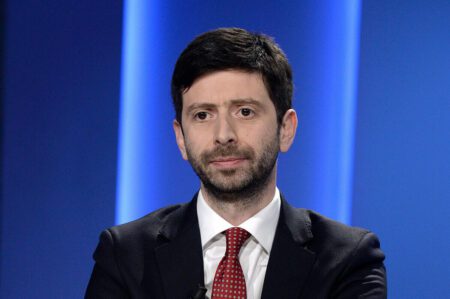
Former health ministers from across the PES family are speaking out in support of Roberto Speranza, who served as Italy’s health minister during the COVID-19 pandemic and has appeared before an Italian parliamentary committee set up by Italy’s right-wing majority to investigate the country’s response to the pandemic.
Italy was one of the first European countries to be hit hard by COVID-19. As the virus spread in early 2020, health ministers had to make urgent decisions with limited information. Salvador Illa, Lena Hallengren, Magnus Heunicke and Marta Temido recall how they worked with Speranza as the virus spread across Europe. Under intense pressure and with limited information, they shared evidence as it emerged, learned from one another and worked together to secure equitable access to vaccines across the EU.
Salvador Illa i Roca, President de la Generalitat de Catalunya y Ministro del Gobierno de España (2020-21), said:
“Durante la pandemia, el contacto con los ministros de sanidad europeos fue vital. Compartíamos información, poníamos en común los avances, las decisiones, lo que funcionaba y lo que no. Nos ayudábamos. Hoy en día sigo manteniendo contacto con muchos de ellos, como con Roberto Speranza. Nuestro empeño fue siempre adoptar medidas coordinadas en el seno de la UE porque éramos conscientes de que solo así podríamos contener el virus.
Roberto Speranza me demostró ser un político inteligente, preocupado por la situación en Italia, capaz de adoptar medidas difíciles que después fuimos replicando en el resto de países de la UE. Y también decidido a impulsar la coordinación europea. Roberto fue uno de los grandes impulsores de la Estrategia Europea de Vacunas para acelerar el desarrollo, la fabricación y la utilización de las vacunas frente al COVID y para garantizar a toda la ciudadanía de la UE un acceso equitativo en igualdad de condiciones. Gracias a esta estrategia, todos los estados miembros tuvimos acceso a las vacunas en igualdad de condiciones. Un éxito rotundo de la UE, reconocido mundialmente, y una muestra de la capacidad de actuación de forma coordinada y solidaria ante una crisis sanitaria sin precedentes.”
Lena Hallengren, former Minister of Health, Sweden, said:
“The COVID-19 pandemic was a difficult time for the world and for countries across Europe. Italy was one of the first European countries to be hit particularly hard, and we followed developments with great concern and sympathy for all those affected. Italy’s experiences provided valuable lessons for the rest of us as the pandemic spread across Europe.
As EU health ministers, we all faced enormous expectations to act, while at the same time dealing with great uncertainty. We supported one another and worked together to protect the health of our citizens and limit the spread of the virus. Perhaps our most important and successful achievement was the rapid development, production and delivery of vaccines.”
Magnus Heunicke, Minister of Education and former Minister of Health, 2019-2022, Denmark, said:
“From my own time as Minister of Health, I know that we had to make difficult decisions in an extraordinary situation. Roberto Speranza made tremendous efforts to protect people and public health. His efforts deserve recognition and should not be diminished by political attacks. Vaccines are crucial tools in protecting the population and saving lives. We must stand by that. Denmark is grateful for Mr. Speranza’s work, dialogue, and advice during the early stages of the global health crisis, when trust, openness, and data sharing between countries were crucial.”
Marta Temido, former Minister of Health, Portugal, said:
“I first heard of Roberto Speranza right at the very start of the COVID-19 pandemic. I was Portugal’s Minister of Health, we were all facing a new virus and the totally uncertainty of the response and television networks were broadcasting images from Lombardy region. As one of the first European Union countries hit by the pandemic, Italy suffered enormously.
The European response to the pandemic was only possible because we all worked together as health ministers. We had to ensure the rapid procurement of essential medical supplies, as personal protective equipment and ventilators. We had to expand hospital and Intensive Care Unit capacity, mobilizing healthcare workers, and supporting cross-border patient transfers. We had to implement coordinated public health measures, like testing protocols, contact tracing, and travel guidelines, while constantly sharing epidemiological data. Furthermore, we joined forces to negotiate collective vaccine contracts at the European level and organize national vaccination campaigns. Throughout all of this, we had to communicate clearly and transparently with our citizens and we kept the public trust – the proof is that we defeated a pandemic we knew nothing about.
I don’t know how many times I heard and learned from Roberto, during those long days. We exchanged online, on whatsapp, on formal meetings and on Employment, Social Policy, Health and Consumer Affairs Council. As Health Ministers we all took very difficult decisions based on the available scientific evidence.
If today Roberto Speranza is facing political trial, I want to stand next to him then.”
Giacomo Filibeck, PES Secretary General, also stands with Roberto Speranza and believes that decisions taken during the pandemic should be assessed fairly, in light of the scientific evidence available at the time and not to be weaponised for political exploitation by the current ruling majority.